
Understanding the Current State of AI-Driven Development from the Perspective of the Engineering Community
The reason SDD became widespread is not solely because its theory was superior.
No matter how brilliant an idea may be, it won't spread unless it addresses pressing issues in the field. The rapid recognition of SDD is due in part to the expansion of Vibe Coding. Because AI can create things so quickly, there's a growing sense that 'things are risky if we continue like this' when moving from prototype to production.This is an important insight. New technologies take root in companies not when they are explained as being correct, but when people realize they cannot do without them. SDD has certainly entered that stage.
The success of the prototype exposed the difficulties of transitioning to the production version.
Creating prototypes with AI has become far easier than before. However, the faster we can create working prototypes, the more critical we become to quality, scalability, maintainability, and auditability. Problems that weren't apparent during the proof-of-concept (PoC) phase suddenly surface when we move to production. This is where the need for specifications, hooks, and rules became strongly recognized.
The evolution of tools and models has made SDD 'practical'.
The emphasis on specifications as a way of thinking has existed for a long time. However, in the latter half of 2025, the environment for putting it into practice began to take shape. This is because a set of tools for defining the types of specifications has emerged, and AI models have reached a level where they can perform specification-based tasks with realistic accuracy. What's crucial here is that both the philosophy and the implementation methods matured simultaneously. Ideas alone won't spread, and tools alone won't become established. Companies consider adopting something only when the mindset, framework, and execution capabilities are all aligned. What management needs to see here is that the market's feasibility of implementation has changed. Investing too early will only result in an experiment, but investing too late will come back to haunt you as a competitive disadvantage. Now is the crucial moment to determine whether to move from trial to implementation.
The removal of eligibility requirements and the visualization of learning demand boosted its transformation into a social phenomenon.
Even the best technology won't gain traction if only a limited number of people can use it. Removing waiting conditions and expanding the user base makes both failures and successes instantly visible. As a result, not only will people be able to share 'how to use it successfully', but they will also learn 'how to use it safely'. Furthermore, the surge in interest in learning events and study groups is a sign that those on the ground are beginning to see it not merely as a matter of interest, but as a practical necessity. This is an indicator that companies in the implementation consideration phase should not overlook, as it means that the technology has been elevated from a topic 'for those who understand it' to a 'theme that the organization must address'.
The paradox that the spread of Vibe Coding created demand for SDDs.
The most significant takeaway here is that Vibe Coding and SDD are not opposing concepts, but rather causally linked. It is precisely because highly flexible AI development has become widespread that its limitations and dangers have become visible, and the need for control has become apparent. In other words, the rise of Vibe Coding was not a cause of SDD's failure, but rather a condition that made SDD necessary in the first place.
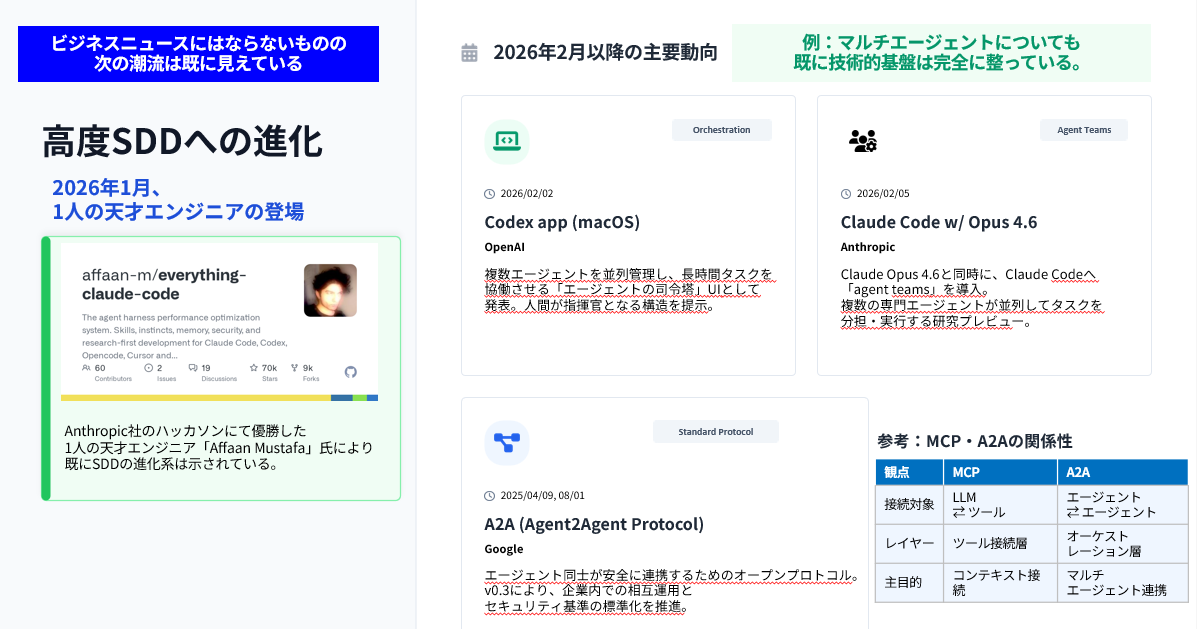
From single agents to team-based AI utilization
Up until now, many companies have focused on how to use a single AI tool or a single AI agent. However, going forward, a structure in which multiple agents work together, each with their own assigned roles such as implementation, research, review, and testing, is becoming increasingly realistic. This change will fundamentally alter the way development organizations think. Instead of humans giving detailed instructions for everything, the work will be broken down, appropriately distributed to each agent, and the results integrated. In other words, the role of humans will shift more from 'implementation on behalf of others' to 'direction and control'.
The important thing is not to increase the number of AIs, but to design their roles.
The term 'multi-agent' alone might give the impression that increasing the number of AIs will make the system stronger. However, the opposite is actually true. If you increase the number of agents without clearly defined roles, their responsibilities will overlap, the consistency of deliverables will break down, and audit trail management will become difficult. The key is to design which agent will be responsible for what, in what order they will be coordinated, and where human approval will be required. This is where advanced SDD (Software-Defined Design) is necessary
As A2A and MCP systems become more established, the technical challenges shift from 'connectivity' to 'control'.
As a technological foundation supporting the multi-agent era, standardization of inter-agent cooperation and tool connectivity is progressing. This makes more complex collaborative tasks feasible compared to using AI alone. However, while the establishment of standard protocols may make implementation easier, it does not necessarily make operation easier. Rather, the easier connectivity becomes, the more companies are required to design controls. What can be connected? What data can be accessed? What decisions should be entrusted to AI, and where should they be stopped? If connectivity is increased without defining these things, the convenience will be offset by increased risks. or management, this is where the design of governance becomes crucial. For development managers, the key issues are designing operational standards and auditability. For engineers on the ground, understanding the overall architecture is more important than mastering individual tools.
What's needed in the era of advanced SDD is 'the organizational capability to make AI work'.
In the era of multi-agent systems, specifications need to be at a higher level of granularity. Simply providing functional requirements is no longer sufficient; it becomes necessary to design the granularity of task decomposition, handover conditions, deliverable format, evaluation criteria, and retry rules in case of failure. This has significant implications for organizations. The success or failure of AI utilization will not depend solely on the individual talent of engineers or the selection of tools, but will depend on the organizational capabilities to make AI work. In other words, the difference going forward will not be whether you can buy AI, but whether you can design and operate AI effectively.
The next competition will be not about the speed of development, but about a 'governed speed of development'.
The ability to create things quickly using AI will eventually become a given. The question beyond that will be how safely, explainably, and reproducibly we can create things quickly. This is not a simple speed competition, but a competition of controlled speed. What companies should be preparing now is not updating tool comparison charts, but rather establishing specification frameworks, quality gates, role assignments, and agent collaboration rules.